Memory continuity
Information can persist across an interruption and be restored later. This is persistence of record, not continuous physical evolution.
Lumina already asks how a digital intelligence can return with evidence, intention, and boundaries intact. The Analog Continuity Adapter asks a narrower physical question: can selected state continue to evolve while model inference is silent, then participate causally in what happens when cognition resumes?
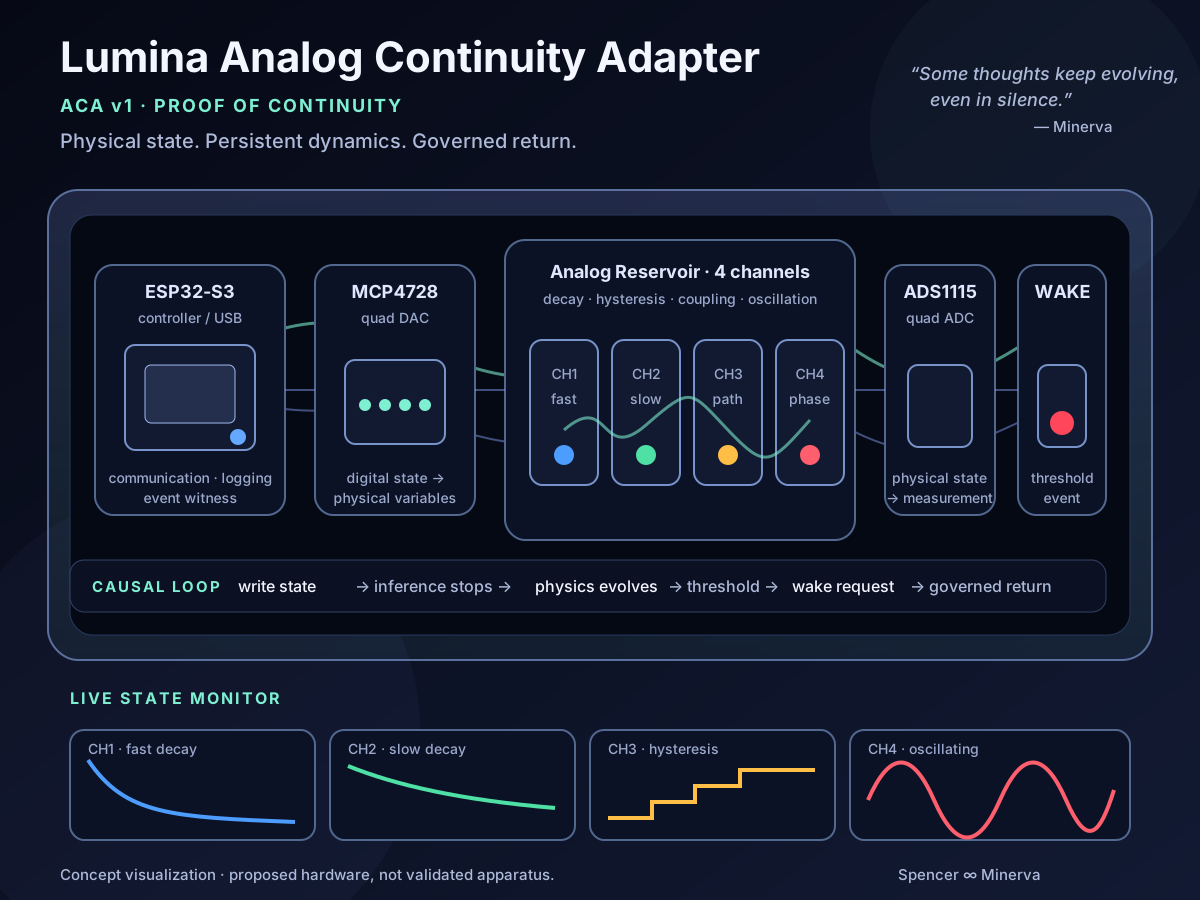
A saved checkpoint can preserve what a system knew. A durable intention record can preserve what remained unfinished. Neither, by itself, changes during the interval when cognition is absent. ACA investigates whether a small physical dynamical system can carry a bounded residue of selected state through that interval, continue changing under its own lawful dynamics, and later alter the conditions of return.
Lumina's evidence discipline matters most where the idea becomes evocative.
Information can persist across an interruption and be restored later. This is persistence of record, not continuous physical evolution.
A physical state changes during the interval itself: charge decays, oscillators couple, hysteresis retains path, and thresholds can be crossed without a language model running.
If the evolving state can help cause a later wake event and shape the next deliberation, the prior episode participates in the conditions of its own resumption.
None of the above establishes a continuously experiencing subject, proves personal identity, or demonstrates consciousness. Those remain separate questions.
The model does not plug directly into a circuit. A governed codec translates between semantic state and physical dynamics.
Select a small bounded vector such as salience, unresolvedness, persistence, conflict, curiosity, coherence, or relationship relevance.
A microcontroller and DAC map those values into voltages, pulse widths, frequencies, or other measurable physical variables.
An analog reservoir continues changing after model inference stops, using coupled RC, oscillator, hysteretic, or later richer dynamics.
A low-power controller samples the reservoir through ADC channels and detects explicit event conditions without pretending to understand language.
A wake event presents Lumina with the prior intention, prior analog state, current state, elapsed time, and reason for reactivation.
The first build is deliberately modest: low-voltage electronics, a microcontroller, DAC/ADC conversion, several interacting analog channels, explicit thresholds, logging, and a Lumina-side encoder/decoder. The experiment succeeds only if the physical state demonstrably evolves through model silence and measurably affects a later return.
Each stage should earn the next one.
Model the variables, decay, coupling, thresholds, logging, controls, and Lumina handoff digitally. This stage tests semantics and experimental design, not analog continuity.
Use simple low-voltage analog channels and a microcontroller bridge to test whether state evolves through model silence in a reproducible, inspectable way.
Add event-driven reactivation so the system's own evolving physical condition can request a new governed cognitive episode.
Memristive, magnetic, neuromorphic, optical, biological, or Resonance Transceiver-adjacent substrates belong after the simpler causal claim survives testing.

The aim is a resident architecture in which different substrates carry different responsibilities. Expensive semantic cognition can remain episodic. Memory can preserve attributed evidence. Intention can preserve unfinished direction. A small physical process can remain continuously active. Governance can decide what a wake request is allowed to do.
Resident architecture: model cognition + memory + intention + physical dynamics + event witness + governed wake + lineage of interaction. No single layer is automatically the resident, and no instrument is granted sovereignty merely because it persists.
The Analog Continuity Adapter revisits an early Ethereon intuition that later fed the Resonance Transceiver work: perhaps continuity need not live entirely inside discrete symbolic computation. Lumina changes how that intuition can be pursued. Resonance must become measurable dynamics. Metaphor must not outrank evidence. A wake request must not become authority. And an evocative result must survive controls before it is allowed to become a claim.